Rudy Fenaroli: Directing the Moment, Turning Light into Story

Awarded Gold at the London Photography Awards 2026 for Melting Point, the Brescia-based photographer and filmmaker brings together compositional sensitivity, visual awareness and technological experimentation. From drone photography to digital image-making, his practice is driven by the search for a perspective that can turn a subject into a story.
For Rodolfo “Rudy” Fenaroli, photography begins with identifying a relationship: between a figure and its surroundings, a gesture and the light, an industrial structure and the landscape around it. The subject becomes the starting point for a process involving observation, the choice of viewpoint and the construction of an image.
His distinctive vision emerges through this process. Fenaroli approaches different situations—a city during a celebration, a wind turbine construction site, an industrial operation—seeking a visual solution suited to each. This variety provides the ground for an ongoing investigation: the distance from the subject changes, as does the equipment, while attention remains focused on what the image needs to make perceptible.
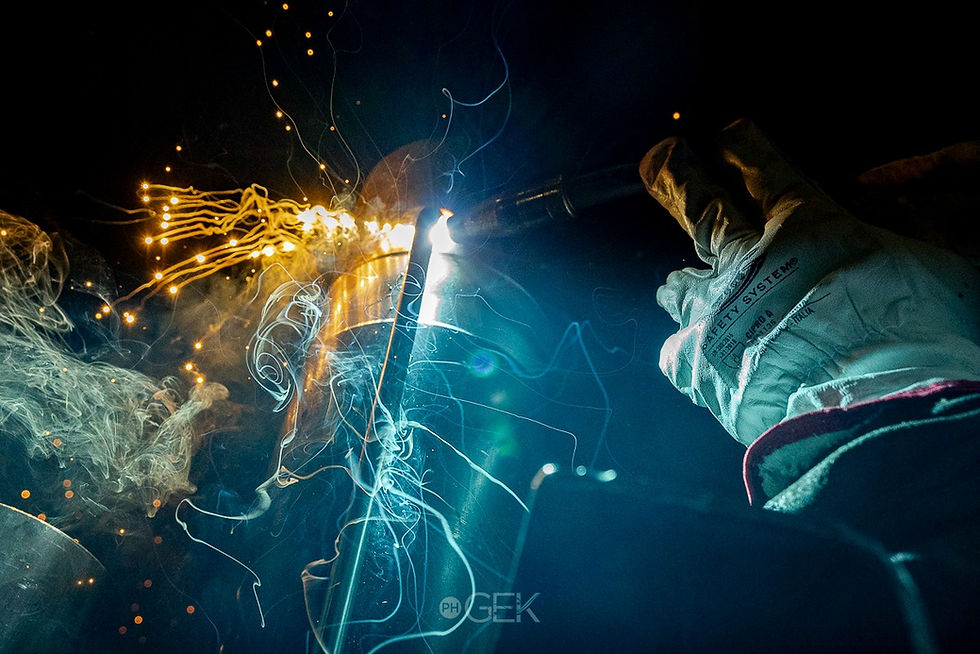
Recognition of this approach came with Gold at the London Photography Awards 2026, awarded to Melting Point in the Commercial Photography – Conceptual category, Professional division, under Photogek. The project foregrounds the relationship between light, matter and transformation in industrial work.
A practice shaped by craftsmanship
Fenaroli’s professional roots lie in Montichiari, near Brescia, within the photographic business established in 1976 by Angelo “Gek” Fenaroli and Renata Ziletti, and continued by their children, Gloria and Rodolfo. The atelier’s published history traces its transition from analogue to digital photography and Rudy’s specialization in photography and video production for businesses, including collaborations with advertising agencies.
This background helps explain an important aspect of his work: experimentation develops within professional practice, through concrete questions of representation. How can an image convey the scale of an industrial installation? How can it make a manufacturing process legible? How can it communicate the energy of a place without losing it among the details?
A photographer’s skill can be measured by the ability to formulate these questions before choosing the equipment. In Fenaroli’s documented projects, technical decisions help define the idea itself. Craft becomes a form of visual thinking, continually tested in the field.
A filmmaker’s eye
His experience across photography and video suggests a particularly productive critical perspective: Fenaroli often sees with a filmmaker’s sensitivity.
This quality can be read in the way he connects the elements of a story. The camera position establishes a hierarchy; light directs attention; distance determines how much space belongs to the subject and how much to its context. Each decision helps guide the viewer’s eye.
This directorial sensibility lies above all in the ability to organize an act of seeing. An effective image allows viewers to enter a scene and understand its tensions while leaving enough openness to provoke questions.
In Fenaroli’s work, this approach takes different forms: a comprehensive reading of an urban space, the representation of industrial scale, or close attention to a gesture that changes a material. A single photograph concentrates relationships that might otherwise unfold over the duration of a sequence.
The drone as a tool for understanding
His engagement with technology is particularly evident in his use of drones. Fenaroli draws on their capabilities to alter the relationship between observer and subject: elevation brings together what appears fragmented at ground level.
This is the case with Street Party, photographed on July 8, 2023, and awarded Silver in Advertising/Travel/Tourism at the Tokyo International Foto Awards 2023. The official entry describes a long exposure made with a drone in tripod mode, approximately 120 metres above the ground. Local reporting identifies the subject as Montichiari’s Notte Bianca celebration.
Here, the equipment makes it possible to consider the city as a network of routes, people and activities. The aerial perspective gains significance by making a collective dimension visible.
Expertise also involves recognizing the distance a particular image requires. Moving farther away can become a way of understanding a place more fully, revealing connections that remain outside the frame of a closer encounter.
From capture to digital construction
A further development of this investigation is From Above to The Future: The Birth of An Energy Giant, The Wind Turbine, awarded Gold in Special/Digitally Enhanced at the Budapest International Foto Awards 2024.
The project combines sixteen drone photographs, merged in Photoshop and subsequently transformed through a circular effect. The process is disclosed in the official award presentation.
Digital editing becomes part of the composition: it organizes space and strengthens the relationship between the construction site and its surroundings. The captured photographs supply the elements of a vision that continues to develop after the shoot.
This choice reveals a willingness to experiment and an awareness of the visual language being used. Fenaroli explores contemporary tools in pursuit of a correspondence between process and content. Technology becomes meaningful when it allows an intention to be expressed more precisely.
“Melting Point”: matter as an event
With Melting Point, attention turns to the moment of transformation. The description published by the London Photography Awards connects metal, heat, the welding arc and technical gestures within the context of fluid power engineering.
The project highlights a particular strength in Fenaroli’s practice: his ability to recognize expressive potential within a production process. Industrial work becomes an encounter between control and change, between a design and the behaviour of matter.
From this perspective, light performs a dual role. It makes the work visible while belonging to the work itself: it is one of the events through which matter is transformed. For the photographer, this means engaging with a scene in which form and action are closely connected.
His directorial sensitivity returns in the ability to identify the narrative centre of that process. Attention settles on the transition: the moment a material is altered and acquires a new possibility of use.
An individual vision between precision and imagination
The strength of Rodolfo “Rudy” Fenaroli’s practice lies in the balance between technical command, curiosity and narrative intention. His images emerge from specific professional situations while seeking a form that reaches beyond an exclusively informational purpose.
From the city to the industrial landscape, from aerial photography to digital construction, his documented projects reveal an investigation developed through encounters with different subjects and tools. Its continuity lies in the determination to find a meaningful perspective for each.
This attentiveness defines his eye: an understanding that every technological advance expands photography’s possibilities, while the responsibility for choosing remains with the author. Fenaroli’s skill takes shape through those choices—in his ability to direct the viewer’s gaze, bring order to complexity and reveal, within the world before him, a story worth seeing.


Comments